
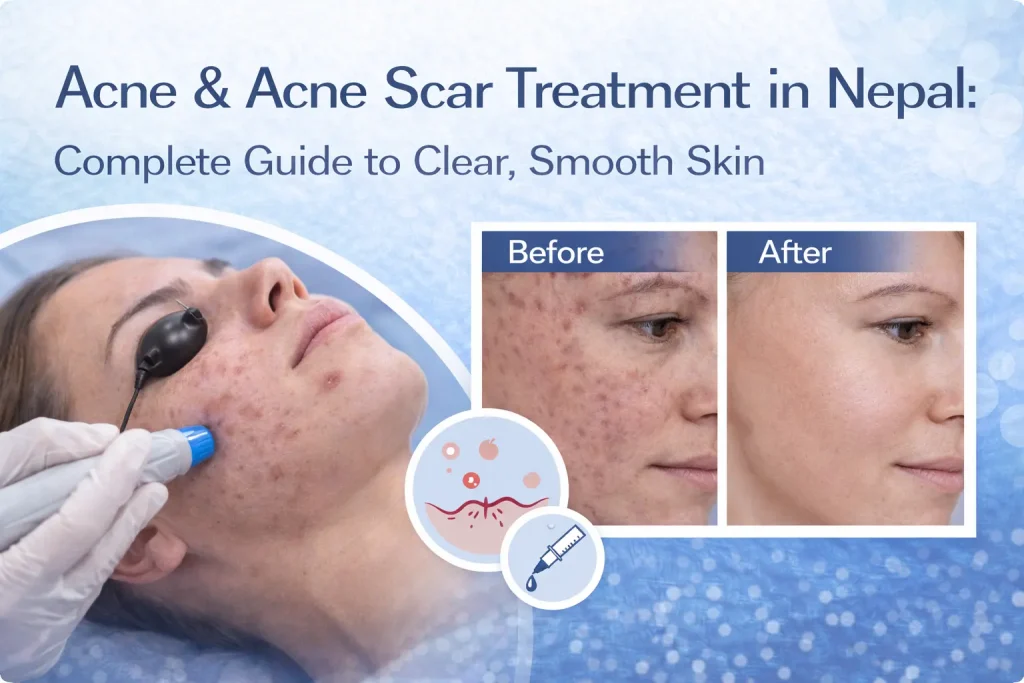

Acne is one of the most common skin concerns worldwide, affecting people of all ages. While active acne can be frustrating, what often lingers behind are acne scars — the marks that remind us of breakouts long after they’ve healed. Acne scars not only affect the skin’s appearance but can also impact self-confidence. Let’s dive into what causes acne scars, the different types, and the best treatment options available today.
At Aakar Dermatology in Pulchowk, Lalitpur, we specialize in treating both active acne and acne scars using advanced technologies like PRP Face (Vampire Facial), CO2 Fractional Laser, Chemical Peels, MNRF, and Subcision.
Why Do Acne Scars Form?
Acne scars form when severe acne damages the dermis (the skin’s deep layer). When acne heals, the skin doesn’t repair itself evenly. Sometimes it makes too much or too little tissue, leaving marks, dents, or dark spots.
The Scarring Process:
- Deep or inflammatory acne (cysts, nodules) damages the dermis
- The body attempts to repair the damage with collagen
- Uneven healing occurs:
- Too little collagen → Depressed scars (dents)
- Too much collagen → Raised scars (bumps)
- Result: Permanent textural changes in the skin
Acne scars are more common in people who:
- Have severe, inflammatory acne
- Pick or squeeze pimples
- Have a family history of scarring
- Delay treating active acne
- Have darker skin tones (more prone to PIH)
Types of Acne Scars
There are mainly two types of acne scars:
1) Atrophic (Depressed Scars)
When the skin heals with too little tissue, leaving dents or holes.
Ice Pick Scars:
- Small, deep holes that look like tiny punctures
- V-shaped and narrow
- Most common type of atrophic scar
- Extend deep into the dermis
- Hardest to treat
Boxcar Scars:
- Wider, sharp dents with defined edges
- U-shaped with a broad base
- Can be shallow or deep
- Look like chickenpox scars
- Common on cheeks and temples
Rolling Scars:
- Wavy, uneven skin surface
- Caused by fibrous bands pulling skin down
- Create a rolling or undulating appearance
- Give skin an irregular texture
- Common on lower cheeks and jawline
2) Hypertrophic or Keloid (Raised Scars)
When the skin heals with too much tissue, forming thick raised bumps.
Hypertrophic Scars:
- Raised but remain within the boundary of the original acne
- Firm, thick texture
- May fade over time
- Common on the chest and back
Keloid Scars:
- Raised and extend beyond the original acne site
- Continue to grow over time
- More common in darker skin tones
- Require specialized treatment
Post-Inflammatory Hyperpigmentation (PIH)
Sometimes people confuse post-inflammatory hyperpigmentation (PIH) — dark marks — with scars, but those are just color changes, not actual scars. PIH fades over time with proper treatment, while true scars involve permanent textural changes.
Causes of Acne Scars
- Inflammatory acne (like cysts or nodules).
- Picking or squeezing pimples.
- Slow or improper healing.
When a pimple is deep or picked/squeezed, it injures the skin. Inflammation (red/swollen pimples) also increases the chance of scars.
Why Picking Makes It Worse:
- Forces bacteria deeper into the skin
- Causes more inflammation and tissue damage
- Breaks down collagen in the dermis
- Introduces surface bacteria into wounds
- Delays healing process
- Increases risk of infection
The golden rule: Never pick, pop, or squeeze acne — let it heal naturally or seek professional extraction.
Treatments for Acne Scars
1) Mild Scars or Dark Marks
These can fade almost completely with creams, sunscreen, and time.
Treatment approach:
- Vitamin C serums
- Retinoids (tretinoin)
- Niacinamide
- Alpha arbutin
- Daily sunscreen (SPF 30+)
- Time (6-12 months)
2) Deeper Scars (Like Ice Pick or Boxcar)
Usually need professional treatments such as microneedling, laser, chemical peels, fillers, etc., to smooth the skin.
Treatment approach:
- Multiple sessions required
- Combination treatments work best
- Results take 3-6 months
- Patience and consistency are key
3) Hypertrophic or Keloid (Raised Scars)
These can flatten with injections or laser treatments.
Treatment approach:
- Steroid injections
- Laser therapy
- Silicone gel sheets
- Cryotherapy (freezing)
- Surgical excision (in severe cases)
Treatment Options at Aakar Dermatology
We offer comprehensive acne scar treatments:
i) Topical Treatment
Prescription-strength creams and serums for mild scarring and PIH.
ii) In-Clinical Treatments
- PRP Face (Platelet-Rich Plasma Facial)
- Chemical Peel
- CO2 Fractional Laser
- MNRF (Microneedling Radiofrequency)
- Subcision
Chemical Peel
Chemical peel is a skin treatment where a chemical solution is applied to the face to remove the top damaged layers of skin.
It helps remove dead skin cells, makes skin smoother and brighter. It also helps with acne, acne marks, fine lines, pigmentation, and uneven texture.
How Chemical Peels Work for Acne Scars:
- Applied to the skin — acidic solution
- Causes controlled damage to outer layers
- Skin peels away over days
- New, smoother skin emerges
- Reduces scar depth gradually
Types of Peels We Use:
- Superficial Peels — For mild scarring and PIH
- Medium Peels (TCA) — For moderate boxcar and rolling scars
- Deep Peels — For severe scarring (rarely needed)
Results:
- Mild scars: 30-50% improvement in 3-6 sessions
- Moderate scars: Visible reduction after 4-8 sessions
- Best combined with other treatments
CO2 Fractional Laser
CO2 laser is a skin treatment that uses a laser to make tiny superficial micro-injuries in the skin while leaving some skin untouched.
It helps to make new collagen form, making skin smoother and tighter. It usually needs multiple sessions for best results.
How CO2 Laser Works:
- Laser creates microscopic wounds in a fractional pattern
- Surrounding healthy skin speeds healing
- Collagen production is stimulated
- Skin resurfaces and scars flatten
- Texture improves dramatically
CO2 Laser Benefits for Acne Scars:
- Highly effective for ice pick, boxcar, and rolling scars
- Resurfaces skin at a deep level
- Stimulates collagen for months after treatment
- Improves texture and tone significantly
- Long-lasting results
What to Expect:
- Sessions needed: 3-6 sessions
- Spacing: 4-8 weeks apart
- Downtime: 5-7 days (redness, peeling)
- Results: 50-80% improvement in scar depth
- Best for: Moderate to severe atrophic scars
PRP Face (Also Called a Vampire Facial)
PRP Face (Platelet-Rich Plasma Facial) is a skin treatment that uses your own blood. It is spun in a machine to separate platelet-rich plasma. This part has growth factors that help healing and collagen production.
The plasma is applied to your face, often with microneedling. Tiny microscopic needles make small holes in the skin so PRP goes deeper, boosts collagen through growth factors, repairs skin, and improves blood flow.
How PRP Face Works:
- Blood is drawn from your arm (10-20ml)
- Blood is centrifuged to separate platelet-rich plasma
- PRP is extracted — contains concentrated growth factors
- Microneedling is performed to create microchannels
- PRP is applied and massaged into the skin
- Growth factors penetrate deeply and stimulate healing
Why PRP is Effective for Acne Scars:
- Natural healing — uses your body’s own growth factors
- Stimulates collagen production for 3-6 months
- Improves skin texture and thickness
- Reduces scar depth gradually
- Safe with minimal risk — it’s your own blood
- Works on all skin types
Benefits of PRP and CO2 Laser
- Reduces acne scars and fine lines.
- Improves skin texture and tone.
- Makes skin look glowing and tighter.
Since PRP uses your own blood, it is natural and carries no risk of harmful reactions.
Additional Benefits:
- Minimizes pores — tightens skin
- Reduces pigmentation — evens skin tone
- Boosts skin hydration — improves glow
- Treats acne — reduces active breakouts
- Anti-aging effects — reduces wrinkles
- Safe for sensitive skin
PRP Procedure
- First, after face wash, numbing cream is applied and left for a few minutes.
Then your blood is drawn and placed in a centrifuge machine. After some time, the plasma is ready and then loaded into a syringe.
Using a dermapen with tiny needles, the plasma is applied to the face while doing microneedling.
- After the session, your skin might feel warm, red, or a little swollen for 1–2 days.
Detailed PRP Process:
Step 1: Consultation & Preparation (15 minutes)
- Skin assessment by Dr. Rajan Tajhya
- Medical history review
- Face cleansing
Step 2: Numbing (20-30 minutes)
- Topical anesthetic applied
- Wait time for numbing effect
Step 3: Blood Collection (5 minutes)
- 10-20ml blood drawn from arm
- Similar to routine blood test
Step 4: Centrifugation (10 minutes)
- Blood spun at high speed
- PRP separated from other blood components
Step 5: Microneedling + PRP Application (30-45 minutes)
- Dermapen creates microchannels
- PRP applied throughout treatment
- Covers entire face
Step 6: Final PRP Application (5 minutes)
- Remaining PRP massaged into skin
- Skin allowed to absorb
Total time: 90-120 minutes
Post Care of PRP Face
- Avoid washing your face with face wash for the first 24 hrs.
- Skip makeup for at least 24 hours or 1 day.
- Don’t touch or scratch your face frequently, and use gentle moisturizer.
- Avoid direct sun exposure; use sunscreen frequently.
- Avoid any active skincare ingredients like retinol, acids (AHA/BHA), vitamin C, or strong exfoliants for at least 6–7 days.
This prevents irritation and allows your skin to heal properly.
Additional Post-Care Tips:
- Sleep with head elevated — reduces swelling
- Avoid hot showers, saunas, steam for 48 hours
- Stay hydrated — drink plenty of water
- Use gentle, fragrance-free products
- Avoid strenuous exercise for 24-48 hours
- Don’t pick or peel any flaking skin
- Apply ice packs if swelling occurs
- Avoid swimming pools for 1 week
Other Advanced Treatments
MNRF (Microneedling Radiofrequency)
Combines microneedling with radiofrequency energy to:
- Deliver heat deep into the dermis
- Stimulate collagen more intensely
- Tighten skin and reduce scars
- Minimal downtime compared to CO2 laser
Best for: Deep boxcar and rolling scars
Subcision
A surgical technique where:
- A needle is inserted under the scar
- Fibrous bands pulling skin down are released
- Allows skin to lift and smooth out
- Often combined with fillers or PRP
Best for: Deep rolling scars and tethered scars
Treatment Comparison Table
| Treatment | Best For | Sessions | Downtime | Results |
| Topical Creams | PIH, mild marks | Daily use | None | 3-6 months |
| Chemical Peels | Mild to moderate scars | 4-8 sessions | 3-5 days | 30-50% improvement |
| PRP Face | All scar types, texture | 3-6 sessions | 1-2 days | 40-60% improvement |
| CO2 Laser | Moderate to severe scars | 3-6 sessions | 5-7 days | 50-80% improvement |
| MNRF | Deep scars, skin tightening | 3-5 sessions | 2-4 days | 50-70% improvement |
| Subcision | Deep rolling scars | 1-3 sessions | 3-5 days | 60-80% improvement |
Best results: Combination therapy (e.g., Subcision + PRP, CO2 Laser + PRP)
How Many Sessions Will I Need?
For Mild Scarring:
- 3-4 sessions of PRP or chemical peels
- Spacing: 4-6 weeks apart
- Total duration: 4-6 months
For Moderate Scarring:
- 5-6 sessions of combination therapy
- Spacing: 4-8 weeks apart
- Total duration: 6-9 months
For Severe Scarring:
- 6-8+ sessions with multiple modalities
- Spacing: 6-8 weeks apart
- Total duration: 9-12+ months
Results are gradual and progressive — patience is essential.
Why Choose Aakar Dermatology for Acne Scar Treatment in Nepal?
- Expert Dermatologist — Dr. Rajan Tajhya specializes in LASER and acne scar treatments with 12+ years of experience.
- Advanced Technology — FDA-approved CO2 Fractional Laser, professional-grade PRP systems, and MNRF equipment.
- Customized Treatment Plans — Every patient receives a personalized approach based on scar type and severity.
- Safe for All Skin Types — Including darker skin tones common in Nepal.
- Comprehensive Care — We treat both active acne and scars for complete skin transformation.
- Proven Results — Before/after photos and satisfied patients across Nepal.
- Convenient Location — Pulchowk, Lalitpur, easily accessible from Kathmandu and Patan.
- Transparent Pricing — No hidden costs, clear treatment plans.
Conclusion
Acne scars don’t have to be permanent. With advanced treatments like PRP Face, CO2 Fractional Laser, Chemical Peels, MNRF, and Subcision, significant improvement is possible. The key is choosing the right treatment for your scar type and committing to a comprehensive treatment plan.
At Aakar Dermatology in Lalitpur, we combine cutting-edge technology with expert dermatological care to help you achieve smoother, clearer, more confident skin.
Book Your Acne Scar Treatment Consultation Today
Ready to transform your skin? Book a consultation with Dr. Rajan Tajhya at Aakar Dermatology.
📞 Call or WhatsApp: +977 9813903982
📍 Location: Himalayan Java Building, 3rd Floor, Damkal Marg, Pulchowk, Lalitpur 44600
🌐 Website: aakardermatology.com
Frequently Asked Questions
Acne scars form when severe, inflammatory acne (cysts, nodules) damages the dermis (deep skin layer). When the skin heals, it doesn’t repair evenly — producing too little or too much collagen, leaving permanent dents or raised bumps. Picking or squeezing acne also increases scarring risk.
There are two main types:
- Atrophic (depressed) scars including ice pick (deep holes), boxcar (wide dents), and rolling (wavy texture).
- Hypertrophic/Keloid (raised) scars which are thick, elevated bumps. Post-inflammatory hyperpigmentation (PIH) is often confused with scars but is just temporary darkening.
While complete removal is difficult, acne scars can be significantly improved (50-80%) with proper treatment. Mild scars may fade almost completely. Deeper scars require professional treatments like PRP, CO2 laser, chemical peels, or subcision. Results depend on scar type, severity, and treatment adherence.
The best treatment depends on scar type. For ice pick/boxcar scars: CO2 Fractional Laser or MNRF. For rolling scars: Subcision + PRP. For mild scars: Chemical Peels. For overall improvement: PRP Face (Vampire Facial). Combination therapy typically provides the best results.
PRP Face uses your own blood’s platelet-rich plasma, which contains concentrated growth factors. These growth factors stimulate collagen production, promote healing, and gradually reduce scar depth. Combined with microneedling, PRP penetrates deep into the skin, improving texture, tone, and scar appearance over 3-6 months.
Numbing cream is applied 30-45 minutes before treatment, making the procedure comfortable. You may feel mild heat or tingling during treatment. After the session, skin feels sunburned for a few days. Most patients tolerate it very well with proper numbing.
Most patients need 3-6 PRP sessions spaced 4-6 weeks apart for visible improvement. Mild scars may improve with 3 sessions, while moderate to severe scars require 5-6+ sessions. Results are gradual — full improvement appears 3-6 months after completing treatment.
- PRP Face: 1-2 days (redness, mild swelling)
- Chemical Peels: 3-5 days (peeling, flaking)
- CO2 Laser: 5-7 days (redness, crusting, peeling)
- MNRF: 2-4 days (redness, slight swelling)
- Subcision: 3-5 days (bruising, swelling)
Most patients return to work after the initial healing period.
Yes! At Aakar Dermatology, we use advanced technology safe for all skin types, including darker tones common in Nepal. The Milesman laser and professional PRP systems can be customized to prevent hyperpigmentation. Dr. Rajan Tajhya adjusts settings based on your specific skin type.
- Initial results: 2-4 weeks after first session (improved texture, glow)
- Noticeable improvement: 2-3 months (scars start flattening)
- Optimal results: 3-6 months after completing all sessions
Results continue improving for months as collagen remodels. Patience is essential.
Active acne should be controlled first before starting scar treatments. Active breakouts can create new scars while you’re treating old ones. Dr. Tajhya will assess your skin and may treat both simultaneously with appropriate medications and procedures.
Results are long-lasting but not necessarily permanent. Once scars improve, they generally stay improved. However:
- New acne can create new scars.
- Aging may affect skin texture.
- Sun damage can worsen appearance. Maintenance treatments every 6-12 months help sustain results.
Avoid for 24-48 hours: Face wash, makeup, touching face, hot water, exercise, sun exposure.
Avoid for 1 week: Active skincare (retinol, acids, vitamin C), swimming, saunas, picking/peeling skin.
Always use: Sunscreen (SPF 30+), gentle moisturizer, prescribed aftercare products.
Pricing varies by treatment type and number of sessions needed. Contact Aakar Dermatology at +977 9813903982 for a personalized consultation and accurate pricing based on your specific scar type and treatment plan.


