

Why People Choose Laser Tattoo Removal
There are numerous valid reasons for wanting tattoo removal:- Bad tattoo placement — Wrong location or poor design
- Professional requirements — New job or career advancement
- Relationship changes — Ex-partner’s name or symbol
- Travel plans — Visa requirements or cultural sensitivity
- Military or government service — Strict appearance standards
- Misspelled or poorly done tattoos — Artistic mistakes
- Personal growth — Your values or style have changed
- Faded or distorted tattoos — Aging has affected appearance
- Cover-up preparation — Making room for new artwork
How Does Laser Tattoo Removal Work?
The science behind laser tattoo removal is fascinating yet straightforward.Understanding What a Tattoo Is
A tattoo is essentially heavy metal particles injected into your skin. Tattoo ink contains heavy metals from the periodic table — different metals create different colors. A tattoo machine uses sterilized needles to inject these heavy metal particles deep into the dermis (the inner layer of your skin). Your immune system immediately recognizes these particles as foreign and tries to remove them. However, since the heavy metal particles are much larger than white blood cells, your body can’t remove them easily. Over time, your body gradually works on breaking them down, which is why tattoos fade with age.How Laser Technology Works
Laser tattoo removal works by breaking the heavy metal particles into smaller fragments that your body can naturally eliminate. Here’s the process:- Intense laser pulses target the tattoo ink
- Light energy is absorbed by the pigment particles
- Particles shatter into tiny fragments (photomechanical effect)
- White blood cells carry the fragments away
- Fragments are processed by the liver
- Body eliminates them through the lymphatic and excretory systems
Picosecond Laser vs. Q-Switched Laser: Why Technology Matters
Not all lasers are created equal. The type of laser used dramatically affects your results, comfort, and number of sessions needed.Picosecond Laser Technology (What We Use)
Picosecond lasers are the most advanced tattoo removal technology available today. They deliver laser energy in picosecond pulses (one trillionth of a second) — 10 times faster than older Q-switched lasers.Benefits of Picosecond Laser:
- Faster treatment — 100 times faster than traditional nanosecond lasers
- Fewer sessions required — Typically 3-7 sessions vs 10-15 sessions
- Better results — More complete ink fragmentation
- Less pain — Shorter pulse duration = less heat = less discomfort
- Reduced scarring risk — Minimal thermal damage to surrounding tissue
- Works on stubborn colors — Effective on green, blue, yellow ink
- Safe for all skin types — Including darker skin tones common in Nepal
Q-Switched Nd:YAG Laser (Older Technology)
Q-switched lasers use nanosecond pulses — slower and less efficient than picosecond technology. While they can remove tattoos, they require significantly more sessions (10-15+) and carry higher risks of scarring and hyperpigmentation. At Aakar Dermatology, we use only the most advanced Picosecond laser technology to ensure you get the best possible results in the fewest sessions.Laser Tattoo Removal Price in Nepal
Pricing for laser tattoo removal in Nepal ranges from NPR 2,500 to NPR 15,000 per session, depending on the size, complexity, and colors in your tattoo. There is no fixed price for tattoo removal — each tattoo is unique. Factors affecting cost include:- Size of the tattoo — Larger tattoos cost more
- Number of colors — Multi-color tattoos require more sessions
- Ink density — Professional tattoos have more ink than amateur ones
- Location on body — Some areas are more complex to treat
- Age of tattoo — Older, faded tattoos are easier to remove
Sample Pricing Examples
To give you an idea of cost, here are approximate prices for different tattoo types:Small, Simple Black Tattoo (2-3 cm):
- Price per session: NPR 2,500 – 3,500
- Sessions needed: 3-5 sessions
- Total cost: NPR 7,500 – 17,500
Medium Single-Color Tattoo (5-8 cm):
- Price per session: NPR 5,000 – 6,000
- Sessions needed: 4-6 sessions
- Total cost: NPR 20,000 – 36,000
Medium Multi-Color Tattoo (8-12 cm):
- Price per session: NPR 10,000
- Sessions needed: 5-7 sessions
- Total cost: NPR 50,000 – 70,000
Large, Complex Multi-Color Tattoo (15+ cm):
- Price per session: NPR 15,000
- Sessions needed: 6-9 sessions
- Total cost: NPR 90,000 – 135,000
How Many Sessions Will I Need?
The number of sessions required depends on several factors:Factors Affecting Session Count:
-
Tattoo Color
- Black ink: Easiest to remove (3-5 sessions)
- Dark colors (blue, purple, dark green): 4-6 sessions
- Light colors (yellow, white, pastel): 6-9 sessions
- Multi-color: 6-8+ sessions
-
Tattoo Age
- Older tattoos: Easier to remove (already fading)
- Fresh tattoos: Require more sessions (dense ink)
-
Professional vs. Amateur
- Amateur tattoos: Shallow ink, fewer sessions (3-5)
- Professional tattoos: Deep, dense ink, more sessions (5-8)
-
Ink Quality
- High-quality ink: More difficult to break down
- Low-quality ink: Fragments more easily
-
Your Skin Type
- Lighter skin: Faster results
- Darker skin: May require adjusted settings and more sessions
-
Your Immune System
- Strong immune system: Faster ink elimination
- Weaker immune system: Slower clearance
Average Session Requirements:
With our Picosecond laser technology:- Small simple tattoos: 3-5 sessions
- Medium tattoos: 4-6 sessions
- Large complex tattoos: 6-9 sessions
- Small tattoos: 8-12 sessions
- Large tattoos: 12-20+ sessions
The Tattoo Removal Process: What to Expect
Step 1: Consultation
Dr. Rajan Tajhya will examine your tattoo and discuss:- Your goals (complete removal or fading for cover-up)
- Expected number of sessions
- Realistic results timeline
- Total estimated cost
- Any concerns or questions
Step 2: Preparation
Before your first session:
- Avoid sun exposure for 2 weeks prior
- Stop tanning (natural or artificial)
- Stay hydrated — drink plenty of water
- Shave the area if there’s hair
- Come with clean skin — no lotions or creams
On treatment day:
- Numbing cream is applied 30-45 minutes before treatment
- Protective eyewear is provided
- Before photos are taken (with consent)
Step 3: Laser Treatment
The actual laser session is quick:- Laser device is positioned over the tattoo
- Short pulses of intense light are delivered
- Tattoo absorbs the energy and ink fragments
- You may hear snapping sounds
- Sensation feels like rubber band snaps (mild with numbing)
- Treatment time: 5-30 minutes depending on size
- Small tattoo (2-3 cm): 5-10 seconds of actual laser time
- Medium tattoo (8-10 cm): 1-3 minutes
- Large tattoo (15+ cm): 5-15 minutes
Step 4: Immediate Aftercare
Right after treatment:
- Ice pack applied to soothe the area
- Antibiotic ointment applied
- Bandage placed over the treated area
- Post-care instructions provided
Step 5: Healing Process
First 24-48 hours:
- Treated area may appear white or frosted immediately
- Redness and swelling develop (like sunburn)
- Possible pinpoint bleeding or blisters (normal)
- Keep area clean and dry
- Apply prescribed ointment
Days 3-7:
- Swelling subsides
- Scabbing or crusting may form (don’t pick!)
- Itching is common
- Continue applying ointment
Weeks 2-4:
- Scabs fall off naturally
- Tattoo appears lighter
- Skin continues healing
- Avoid sun exposure
Weeks 4-8:
- Further fading becomes visible
- Body continues clearing ink particles
- Ready for next session
Before and After Results
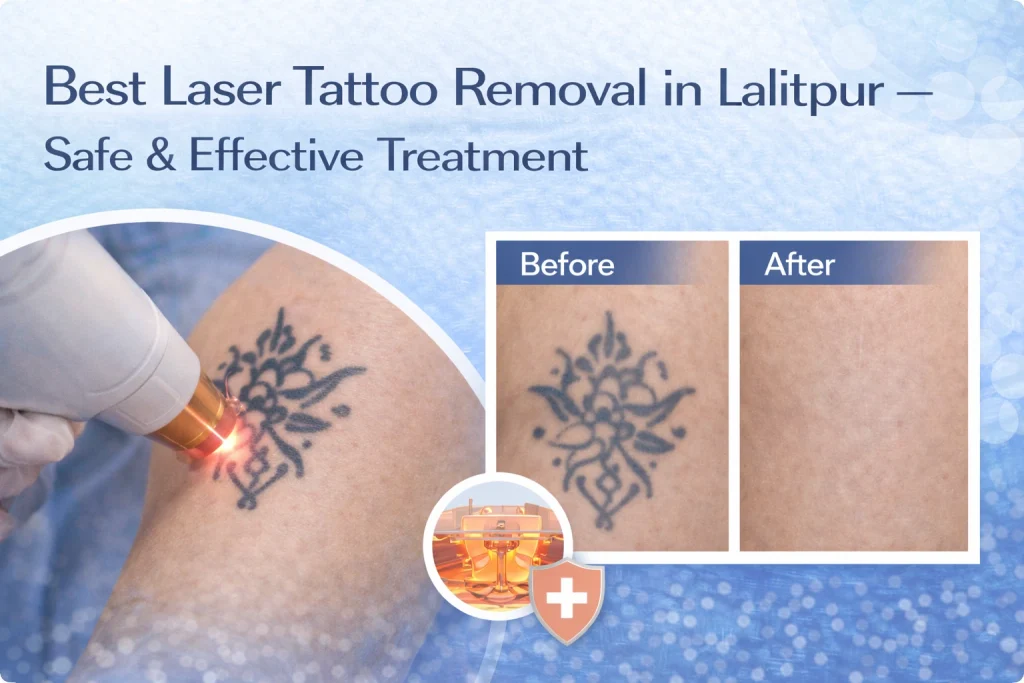
Tattoo removal is a gradual process. You’ll see progressive fading with each session.What to Expect Session-by-Session:
After Session 1:
- 20-30% fading
- Tattoo appears lighter but still clearly visible
After Session 2:
- 40-50% fading
- Significant lightening, some areas may be very faded
After Session 3:
- 60-70% fading
- Tattoo becoming much less visible
After Sessions 4-6:
- 80-95% fading
- Most tattoos are barely visible or completely gone
Factors Affecting Final Results:
- Black tattoos: Often 90-100% removal
- Dark blue/green tattoos: 80-90% removal
- Multi-color tattoos: 70-85% removal
- Yellow/pastel tattoos: 60-80% removal
Safety and Side Effects
Laser tattoo removal is generally very safe when performed by trained professionals using proper equipment.Common, Temporary Side Effects:
Normal reactions (usually resolve in 1-2 weeks):
- Redness and swelling — Like a sunburn
- Pinpoint bleeding — Small dots of blood
- Blisters — Fluid-filled bubbles (sign of healing)
- Scabbing or crusting — Protective layer forming
- Itching — Part of healing process
- Temporary darkening — Ink may appear darker before fading
Potential Risks (Rare with Proper Care):
Infection (if aftercare not followed)
- Risk: <1% with proper hygiene
- Prevention: Keep area clean, apply prescribed ointment
Hyperpigmentation (darkening of skin)
- Risk: 2-5% (higher in darker skin tones with older lasers)
- Prevention: Avoid sun exposure, use proper laser settings
Hypopigmentation (lightening of skin)
- Risk: 1-3% (usually temporary)
- Prevention: Proper laser settings, adequate healing time between sessions
Scarring (raised or textured skin)
- Risk: <2% with Picosecond laser
- Prevention: Don’t pick scabs, follow aftercare instructions
Incomplete removal
- Some colors (yellow, white, pastel) may not fully remove
- Multiple sessions maximize fading
Pre-Existing Scarring
Important: If your tattoo was done over scar tissue, the scar may become visible after tattoo removal. This is not caused by the laser — the tattoo was simply covering it. Laser does not create scars when used properly.Why Choose Aakar Dermatology for Tattoo Removal?
-
Expert Dermatologist — Dr. Rajan Tajhya
Qualifications:
- M.B.B.S. from Kathmandu University
- Specialized Dermatology from Tribhuvan University (2010)
- Certified in LASER and Dermato-surgery
- Extensive training in Picosecond laser technology
Approach:
- Prioritizes patient safety and realistic expectations
- Prefers gradual, safe removal over rushed treatment
- Ethical practice — honest about what’s achievable
- Calm, patient-focused consultation style
-
Advanced Picosecond Laser Technology
We use the most advanced laser technology available:
- Picosecond laser — Not outdated Q-switched
- Faster results — Fewer sessions needed
- Less pain — Shorter pulse duration
- Reduced scarring — Minimal thermal damage
- Safe for all skin types — Including darker tones
FDA-approved technology
Multiple wavelengths — Targets different ink colors Many clinics in Nepal still use older Nd:YAG Q-switched lasers, which require 10-20+ sessions for results you can achieve in 5-8 sessions with Picosecond technology.-
Proven Track Record
- Minimal scarring
- Excellent fading results
- Satisfied patients from Kathmandu, Lalitpur, Pokhara, Biratnagar, and beyond
-
Transparent Pricing
- No hidden costs
- Clear upfront estimates
- Flexible payment options
- Honest about realistic outcomes
-
Convenient Location
- Kathmandu Valley
- Patan
- Bhaktapur
- Surrounding areas
Post-Treatment Care Instructions
Proper aftercare is essential for best results and avoiding complications.First 24-48 Hours:
- Keep the area bandaged — Remove after 24 hours
- Apply ice packs — 15 minutes every 2-3 hours (reduces swelling)
- Gently clean with mild soap and lukewarm water
- Apply prescribed ointment — 2-3 times daily
- Keep area dry — Avoid swimming, hot tubs, saunas
- Avoid sun exposure completely
- Wear loose clothing — Prevent friction
- No alcohol — Thins blood, increases bleeding risk
Days 3-14:
- Continue applying ointment until fully healed
- Do NOT pick scabs — Let them fall off naturally
- Avoid scratching even if itchy
- Gentle cleansing daily
- No direct sunlight — Wear SPF 50+ if must go outside
- Avoid strenuous exercise that causes sweating on treated area
- Watch for infection signs — Increased pain, pus, fever (contact doctor immediately)
Long-Term (Between Sessions):
- Sun protection — Always use SPF 30+ on treated area
- Stay hydrated — Helps body clear ink particles
- Healthy lifestyle — Good immune function aids removal
- Wait 4-8 weeks between sessions
- Attend follow-up appointments
Tattoo Removal vs. Tattoo Cover-Up: Which Is Right for You?
Consider Full Removal If:
- You want completely clean skin
- You don’t want any tattoos
- Professional requirements demand no visible tattoos
- You have the time and budget for full treatment course
Consider Partial Fading for Cover-Up If:
- You want new ink in the same location
- You want to save money (fewer sessions)
- You want faster results (2-4 sessions vs 5-8)
- Your tattoo is too large for complete removal budget
Ready to Remove Your Tattoo?
Don’t let an unwanted tattoo hold you back. Whether it’s for professional reasons, personal growth, or simply changing your mind — we’re here to help.Book your consultation with Dr. Rajan Tajhya today.
Contact Aakar Dermatology 📞 Call or WhatsApp: +977 9813903982 📍 Location: Himalayan Java Building, 3rd Floor, Damkal Marg, Pulchowk, Lalitpur 44600 🌐 Website: aakardermatology.com 📘 Facebook: @aakardermatology 📷 Instagram: @aakardermatology Send us a photo of your tattoo for a personalized price quote!Frequently Asked Questions
Most patients describe the sensation as similar to getting the tattoo, but much quicker. It feels like rubber band snaps or hot grease splatters. We apply numbing cream 30-45 minutes before treatment, which significantly reduces discomfort. The actual laser time is very short — even large tattoos only take 5-15 minutes of actual laser exposure.
With our Picosecond laser, most tattoos require 3-7 sessions depending on size, color, and ink density. Simple black tattoos may need only 3-5 sessions, while large multi-color professional tattoos may need 6-9 sessions. Sessions are spaced 4-8 weeks apart.
Pricing ranges from NPR 2,500 to NPR 15,000 per session depending on tattoo size and complexity. Small simple tattoos start at NPR 2,500, while large complex multi-color tattoos can be NPR 15,000 per session. Send us a photo of your tattoo for an accurate quote.
Black tattoos typically achieve 90-100% removal. Dark colors (blue, purple, dark green) usually fade 80-90%. Light colors (yellow, white, pastel) are more difficult and may achieve 60-80% removal. Some stubborn colors may not fully disappear but will fade significantly.
Black and dark blue respond best to laser treatment. Green, red, orange, and purple also respond well. Yellow, white, and flesh-toned inks are most difficult to remove and may not fade completely. Multi-color tattoos require multiple wavelengths and more sessions.
Yes! Our Picosecond laser is safe for all skin types, including darker skin tones common in Nepal. We adjust laser settings specifically for your skin type to prevent hyperpigmentation. Older Q-switched lasers carry higher risks for dark skin, which is why our advanced technology is important.
When performed correctly with proper technology, laser tattoo removal rarely causes scarring. Our Picosecond laser has a <2% scarring risk because it uses minimal heat. However, if your tattoo was placed over existing scar tissue, that scar may become visible after removal (the tattoo was covering it).
Absolutely! Many patients choose partial fading (2-4 sessions) to lighten the existing tattoo enough for a better cover-up. This is often more cost-effective than complete removal if you plan to get new ink.
- 2 weeks before: Avoid sun exposure and tanning.
- 1 week before: Stop retinoids and exfoliating products.
- 24 hours before: Avoid alcohol and blood-thinning medications (unless prescribed).
- Day of treatment: Come with clean skin, no lotions or makeup.
You’ll notice initial fading within 2-3 weeks after your first session as your body clears fragmented ink. Maximum fading from each session appears at 4-8 weeks. Results are progressive — each session builds on the previous one.
Avoid strenuous exercise for 24-48 hours after treatment, especially if it causes sweating on the treated area. After 48 hours, you can resume normal activity, but protect the area from sun and friction. Swimming should be avoided for 2 weeks.
Picosecond lasers deliver energy 10 times faster than Q-switched lasers, causing better ink fragmentation with less heat damage. This means: fewer sessions (3-7 vs 10-15), less pain, reduced scarring risk, and better results on stubborn colors. It’s simply more advanced technology.
Laser removal is non-invasive, breaks down ink gradually, has minimal scarring risk, and works on any tattoo size. Surgical excision involves cutting out the tattooed skin, leaves a scar, and is only practical for very small tattoos. Laser is the gold standard for tattoo removal.
It’s best to wait at least 6-8 weeks after getting a tattoo before starting removal, allowing your skin to fully heal from the tattooing process. Removing a fresh tattoo too soon can increase scarring risk.


